Dear friend,
Have you ever wondered what obedience to God is? I think there are seasons when obedience doesn’t look loud or impressive. It doesn’t look like having the right verses memorized or the perfect advice ready. The other day, an incident made me think that, sometimes, obedience looks like simply showing up.
I have a friend who has been going through a really difficult time. And for reasons I still can’t fully explain, I felt a quiet nudge in my heart to approach her every single time she came to church. Not to fix, and not to probe, but just to be present, to ask how she was doing, to sincerely ask and genuinely listen to her story.
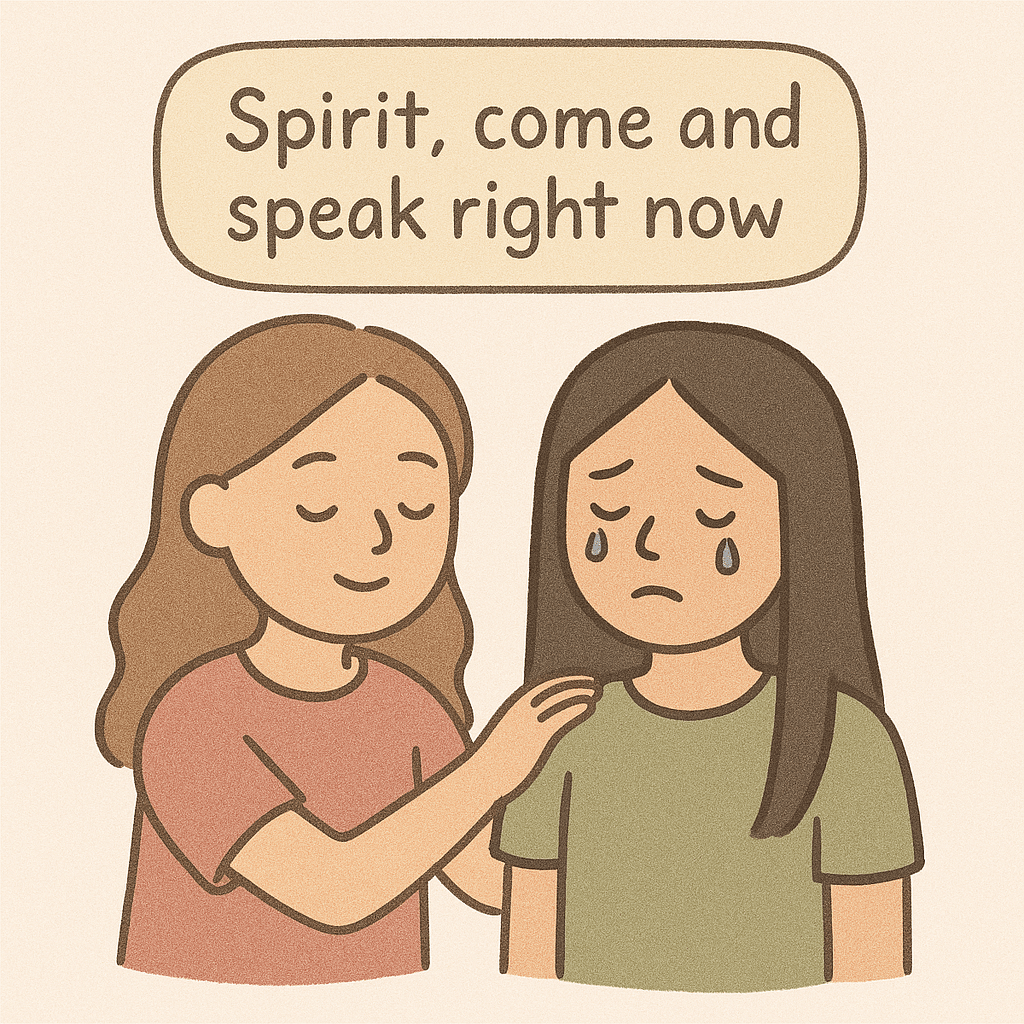
One Sunday, when I asked her that simple question, her tears just wouldn’t stop. She slowly expressed her inner deep thoughts, and slowly her tears started rolling down her cheeks—raw, heavy, uncontrollable. So we walked together to the prayer room (or, what we call the “engine room”. Isn’t it so cool?) tucked away from the main hall. I thought because it was quiet there, we could get away from any curious glances.
That day reminded me that obedience isn’t always about doing something big for God. Sometimes it’s about responding to a small invitation:
“Go talk to her.”
“Listen.”
“Stay.”
And that kind of obedience—quiet, unseen, relational—is often where I think God does His deepest work.
When the Heart Finally Speaks
Once we settled down, she opened her heart.
She spoke about comparison—how she constantly measures herself against others. She talked about envy—how she feels bitterness when she sees others succeeding. She confessed the anger she hides from her friends but releases on her family, the people who feel safest to her and yet bear the brunt of her pain.
She said she feels incompetent. She feels ineloquent. She believes others speak beautifully while she stumbles over her words. She feels like she’s falling behind in life while everyone else is moving forward. She thinks others are thriving—and she’s stuck.
As she spoke, I realized how familiar these thoughts are. How easily these lies sneak into our minds and disguise themselves as truth. How heavy they become when we carry them alone.
But for the first time, I didn’t feel the urge to correct her thoughts or rush to Scripture to counter every lie spoken. I didn’t feel pressure to sound wise or spiritual. I didn’t feel the need to say the right thing.
I just wanted to hear her story.
And maybe that was the most loving thing I could do in that moment—to witness her pain without interrupting it.
Choosing Prayer Over Answers
There was a moment when everything went quiet. I used to fear pauses like this, thinking silence meant something was wrong. But I realized that fear came from me, not the moment. This silence wasn’t awkward at all—it felt full, as if it was gently waiting to be met. And in that silence, I felt it clearly: we needed to pray, now.
Not later. Not after things made more sense. Not once I had found the perfect words, but right then. So we began praying while she was still in tears, and I gently asked if we could bring everything to Jesus together. I began to pray over her.
We laid it all before Him—the envy, the anger, the insecurity, the exhaustion, and the lies she had been believing about herself. There was no pressure to organize the pain or make it sound presentable. Nothing needed to be packaged neatly. I continued praying for the Holy Spirit to remain with us, and if there was anything He wanted to speak, that He would speak directly to her heart.
In that moment, prayer helped clear what had been blocking her connection to Jesus—the dirt, the anxiety, the quiet noise that had been building up in her heart. When she didn’t have the words, the emotional strength, the confidence, or even the willingness to pray, I was humbled to be there as a friend and give voice to what she couldn’t yet offer.
In the moments of prayer, I began to realize something deeply freeing: it was never my responsibility to say the right things. That was God’s role. He already knew her struggles long before she put them into words, and He would be the one to meet her in them.
Not my insight. Not my encouragement. Not even my empathy. None of it was the answer. That was God’s role.
Because prayer has power, I prayed for surrender. I prayed for God to open her heart to the Holy Spirit, and for Him to continue speaking into her life. And as much as that prayer was for her—to lay her anxieties before God—it was also a surrender of myself. I was reminded that I was never meant to be the source of wisdom or peace. I was simply a vessel, helping her reconnect to Him, praying on her behalf when she had no words left to offer—so she could hear Him again.

The Freedom of Being a Vessel
There was something incredibly freeing about realizing that I am not the source. I am not the healer. I am not the savior. I am not the solution. I am simply a vessel—one the Holy Spirit chose to use in that moment.
And to be able to acknowledge that fact is slowly lifting a weight off my shoulders I didn’t even know I was carrying. Serving her became so light. It didn’t feel heavy, it didn’t feel draining, it didn’t feel like I had to perform or prove anything – all because all the burden was already being held by God. All the glory belonged to Him.
I was able to walk out of that engine room with so much joy, not exhaustion. With peace, not pressure. With gratitude, not pride. It was such a humbling moment to be able to help a friend, and that helping a friend didn’t mean absorbing her pain, but it meant surrendering it together. And so I thought, maybe that’s what obedience really looks like: trusting God enough to step aside and let Him work.
What It Means to Be a Friend
Friend, I used to think being a good friend meant having good advice, saying wise things, offering clarity in moments of confusion. But now, I am able to think that being a good friend often means something much simpler and much braver.
It means helping someone find their way back to Jesus when their path feels clogged and unclear. It means reminding them—sometimes without words—that they don’t have to carry everything alone. It means choosing prayer when answers feel insufficient.
I don’t think we need to unclog the entire system. We don’t need to fix the source. We just need to help clear the way. And then, peace comes; Not from us, but from God.
A Prayer
Jesus,
We bring You everything
we’ve been holding too tightly.
Every comparison.
Every jealous thought.
Every hidden anger.
Every fear of falling behind.
You see what weighs
on our hearts—
even the things
we don’t know how to name.
You invite us
to come to You,
not cleaned up,
not eloquent,
not strong—
but honest.
Teach us to surrender
instead of striving.
To pray
instead of performing.
To trust that
You are near, that
You care, and that
You are enough.
Clear what has been blocking
our hearts from You.
Restore peace where
there has been noise.
Replace lies with truth.
And remind us that
Your grace is sufficient,
Your timing is perfect, and
Your love is unwavering.
We lay it all at Your feet.
Not because we are strong—
but because You are.
Amen.
 BubbleBabble
Leave a comment